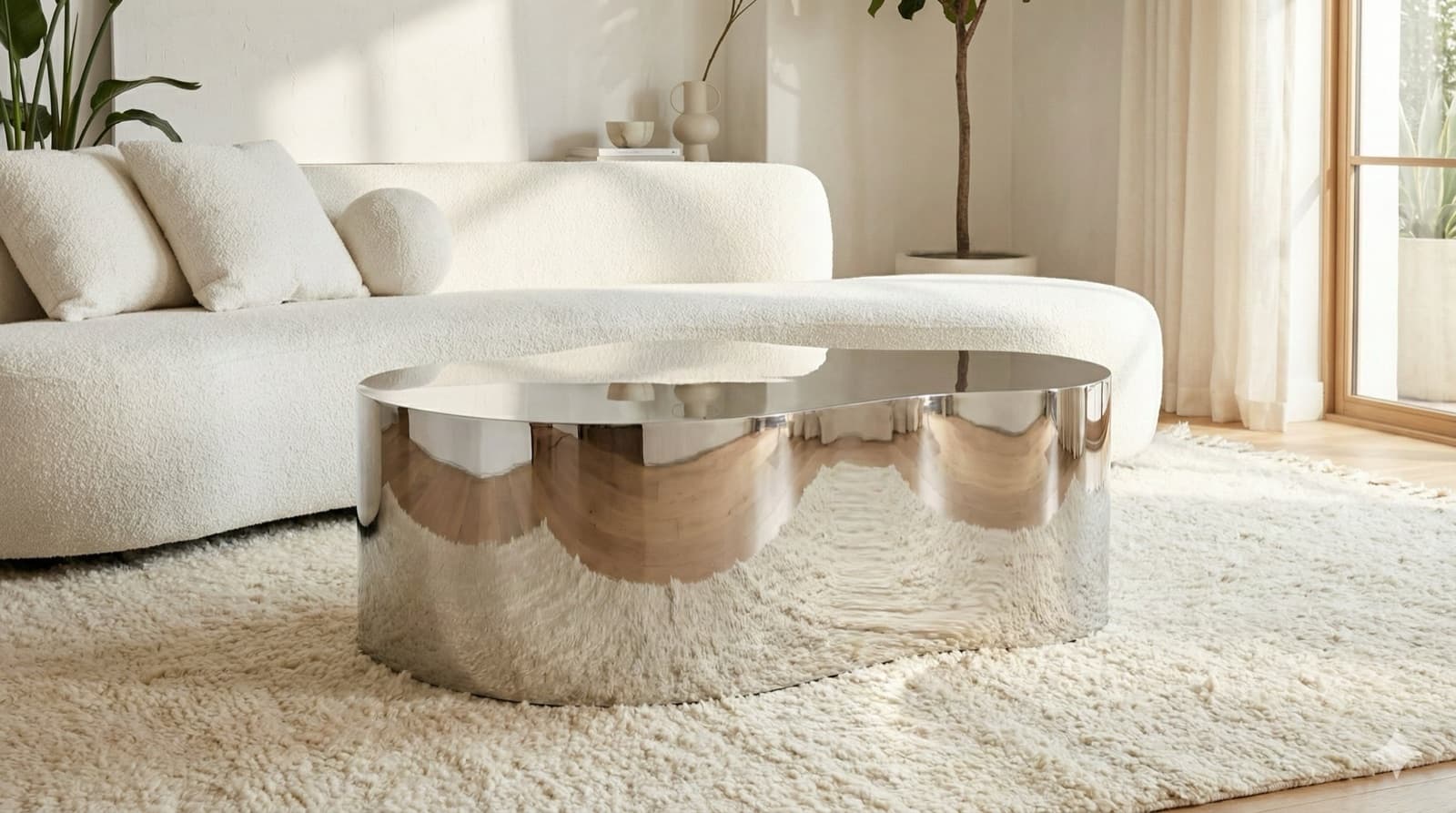
This describes how our bespoke pieces — The Hero, The True C and The Grid — are made to order in Melbourne. Pieces in our sourced range are manufactured by our partners, and each product page states its own origin.
There is a particular kind of light that only lives on hand-polished steel. It is deeper than a coating and quieter than a chrome plate — a reflection with weight to it. Getting there is slow, and deliberately so.
A raw 304 stainless surface arrives dull and grey, scattered with the fine scratches of milling and handling. To bring it to a mirror, we work through progressively finer abrasives — each pass removing the marks left by the one before, until the scratches become too small for the eye to catch and the surface begins to behave like water.
The machine can't feel the metal
Automated polishing exists, and for flat sheets at volume it is faster. But our pieces are curved, folded, welded. A radius needs a different pressure than a flat face. A weld seam needs to disappear without flattening the form around it. These are decisions made by hand, in the moment, by someone watching the reflection change as they work.
You don't polish to a number. You polish until the room shows up in the steel.
It means no two pieces are bit-for-bit identical, and we think that is the point. A Chrome Piece carries the evidence of a person having made it — not as flaw, but as authorship.
Patience as a material
The last stages are the longest. The difference between a good finish and a true mirror is measured in hours that produce almost no visible change — right up until they do. It is unglamorous work, and it is the whole product. When a piece finally throws a clean, undistorted reflection back at us, we know it is ready to leave the workshop.